
The Bad Hire Aftermath

You tried it hiring virtual assistant support, got burned, and wrote off the idea of getting help.
One bad virtual assistant hire and it’s enough to make you hesitate to ever try again.
You posted a job.
You got absolutely flooded with applications.
You picked the one who looked the most polished or you connected with the best.
And a few months later, you were back where you started.
Sound familiar?
The time lost.
The onboarding that went nowhere.
The client work that slipped while you were busy fixing mistakes.
That experience burns you. And it usually happens when you’re hiring without a real vetting layer between you and the people you’re choosing from.
The Real Problem
Most leaders assume they made a bad call. But the issue usually isn’t your judgment. It’s the system you were hiring through.
Most hiring platforms are built for volume, not quality.
Anyone can create a profile.
Anyone can apply.
And it’s on you to sort through the noise.
There’s no consistent screening.
No deep reference checks.
No structured evaluation of how someone actually works.
You’re not being protected. You’re being handed options and told to figure it out.
And when you’re already busy running a business, that’s a risky place to be.
Why Traditional Hiring Doesn’t Solve It Either
You might think, “I’ll just hire in-house instead.”
But that comes with its own challenges:
Long hiring timelines that stretch for weeks or months
High salary commitments before you even know if it’s the right fit
Limited visibility into how someone actually performs day-to-day
And even then, you’re still making a bet.
Because interviews don’t always reveal how someone shows up once the work begins.
What Actually Needs to Be Different
Most leaders don’t just need help. They need ownership.
Someone who can:
Manage communication without constant direction
Stay ahead of deadlines instead of reacting to them
Understand the bigger picture, not just complete tasks
That level of support doesn’t come from luck.
It comes from structure.
What It Looks Like When the Process Is Done Right
We’ve worked with leaders who came to us after going through this exact cycle.
One client, a business owner juggling multiple revenue streams, needed support across:
Inbox and communication management
Calendar and scheduling
Billing and expense tracking
Ongoing project coordination
But what they were really missing wasn’t just help. It was consistency and follow-through.
Before we ever introduced a virtual assistant, we handled the heavy lifting upfront:
In-depth screening and background checks
Real-world experience validation
Test projects to assess critical skills like attention to detail, proactivity, tech savviness, and communication skills.
Structured interviews based on the actual responsibilities of the role
Alignment on availability and long-term fit
By the time they met their assistant, it wasn’t a gamble. It was a curated match.
Now, months in, that assistant owns their inbox, manages scheduling, and keeps key processes moving without constant oversight.
Not because they’re “perfect,” but because they were set up to succeed from the start.
What a Real Vetting Process Actually Means
At Alpine Virtual, we don’t rely on resumes or surface-level impressions.
Every assistant goes through a multi-step vetting process designed to answer one question:
Can this person actually support a business at a high level?
That includes:
Thorough resume and experience review by real people
Test projects to assess critical skills like attention to detail, proactivity, tech savviness, and communication skills.
Structured interviews based on real client scenarios
Reference checks and consistency validation
We’re not looking for the most applicants.
We’re looking for the right ones.
Because when vetting happens upfront, everything that follows gets easier.
“But What If It Happens Again?”
That hesitation makes sense. When you’ve had a bad experience, it’s hard not to expect a repeat.
The truth is, no hiring decision is ever completely risk-free. But a structured process dramatically changes the odds.
And more importantly, it changes what happens if something isn’t working because you’re not left on your own trying to fix it.
You Don’t Have to Write Off the Entire Model
One bad experience doesn’t mean the idea of support is broken. It usually means the process behind it was.
When the right systems are in place, a virtual assistant doesn’t just “help.”
They take ownership of the things that have been sitting on your plate for too long.
And they give you space to focus on what actually moves your business forward.
Here’s an email we received from a client recently, after getting matched with the right assistant after five years of bad hiring experiences:
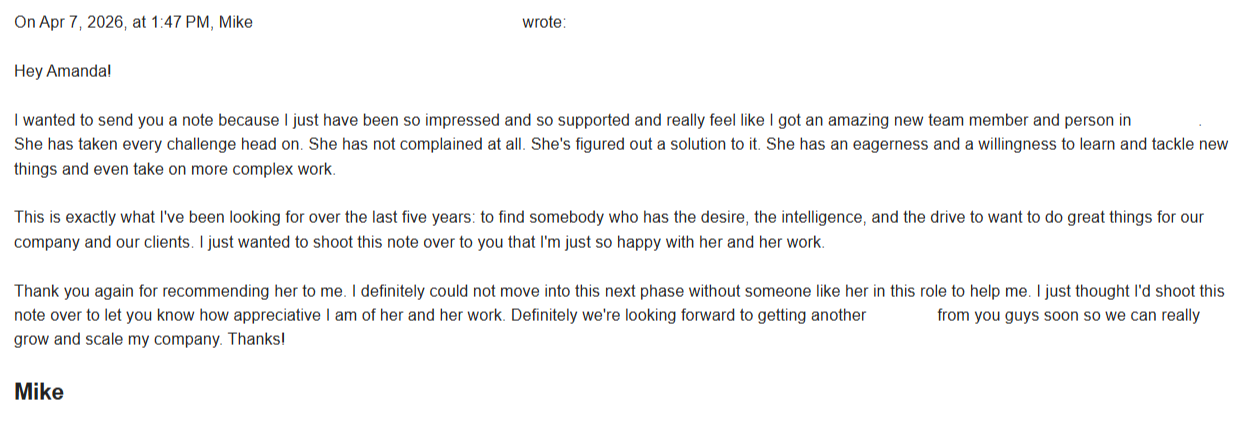
Client sharing their experience after hiring a virtual assistant through Alpine Virtual
That’s what it looks like when it’s done right. If you’ve had a tough experience before, it makes sense that you’d hesitate to try again.
But most of the time, it’s not the idea of hiring a virtual assistant that failed.
It’s how the hiring happened.
And when that part changes, everything else does too.
Ready to Try Again, the Right Way?
If you’ve been hesitant to delegate after a tough experience, you’re not alone.
But staying stuck there will cost you more than the bad hire ever did.
If you want to see what a structured, people-first approach to hiring support actually looks like, we’d love to show you.